
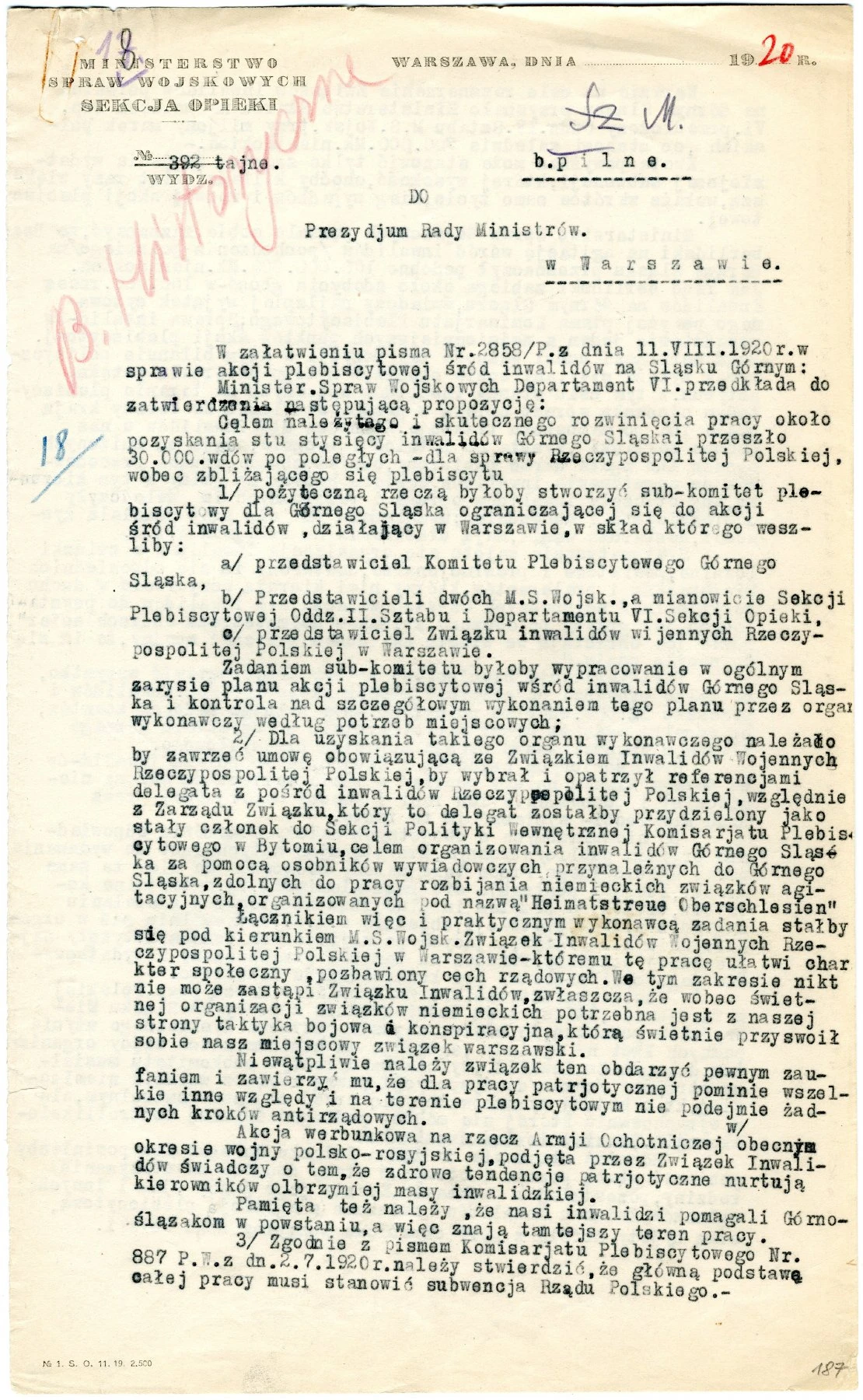
What Versailles established
The Treaty of Versailles, signed on 28 June 1919, provided in Article 88 for a plebiscite in a defined part of Upper Silesia. It did not simply award the whole region to the overall winner. The commission was to report commune results and recommend a border, taking geographical and economic conditions into account.
Sources for this passage
- Treaty of Versailles, Article 88 and Annex; editorial notes in FRUSArticle 88 and Annex §5
The Annex to Article 88 admitted people aged at least 20 who had been born in the plebiscite territory or met its residence requirements, and who had not been deprived of voting rights. People born in the region could return to vote even if they no longer lived there.
Sources for this passage
- Treaty of Versailles, Article 88 and Annex; editorial notes in FRUSArticle 88 Annex §4
The plebiscite campaign
Polish and German campaigns used both languages and religious, cultural and economic arguments. Promises of future autonomy formed part of the competition. Violence and pressure during preparations do not mean that every vote can be explained solely by intimidation or the voter’s language.
Sources for this passage
- Upper Silesia plebiscite – an intensive course in Polish identityFic: campaign and household language; leaflet p. 1: autonomy
- Powstania śląskie 1919–1921: exhibition leafletFic: campaign and household language; leaflet p. 1: autonomy
Wojciech Korfanty headed the Polish Plebiscite Commissariat at the Lomnitz Hotel in Bytom. Kurt Urbanek led the German commissariat in Katowice. The campaign involved newspapers, meetings and organisational work; competition extended beyond electoral argument.
Sources for this passage
- II Powstanie ŚląskieParagraph on commissariats and spring campaign
Polling day
The plebiscite took place on 20 March 1921. Voters chose between remaining in Germany and joining Poland. Ballot cards carried the names of both states. The Allied commission supervised the vote; it was not a plebiscite administered by the League of Nations.
Sources for this passage
- The Upper Silesian plebiscite of 20 March 1921 – the course of votingVote: voting procedure; treaty: commission powers
- Treaty of Versailles, Article 88 and Annex; editorial notes in FRUSVote: voting procedure; treaty: commission powers
Results and their source
An IPN account dated 11 January 2022 reports 707,393 votes for Germany and 479,365 for Poland. The chart below uses these totals. Other institutional accounts give slightly different totals. The broad result is consistent: roughly 60% of valid votes for Germany and 40% for Poland.
Full reconciliation requires the commission’s original return. Chart percentages are calculated from the sum of votes for the two options.
Sources for this passage
- The Upper Silesian plebiscite of 20 March 1921 – the course of votingVote: final results paragraph; Third: plebiscite results
- Plebiscyt i III Powstanie Śląskie 1921 rokuVote: final results paragraph; Third: plebiscite results
IPN, 11 January 2022. Percentages calculated from 1,186,758 votes for the two options; invalid ballots excluded from the denominator.
Towns and rural communes
Results varied between localities. Large towns generally favoured Germany, while many rural communes in the eastern part had Polish majorities.
Sources for this passage
- The Upper Silesian plebiscite of 20 March 1921 – the course of votingVote: geographic variation; Fic: results
- Upper Silesia plebiscite – an intensive course in Polish identityVote: geographic variation; Fic: results
Household language did not determine national identification or a plebiscite vote. Some inhabitants used Polish or Silesian varieties of speech while favouring Germany. Regional, religious and family attachments could overlap with Polish or German affiliations.
Sources for this passage
- Celebrating the nation: the case of Upper Silesia after the plebiscite in 1921Identity: pp. 50–51; Fic: paragraphs on language and propaganda
- Upper Silesia plebiscite – an intensive course in Polish identityIdentity: pp. 50–51; Fic: paragraphs on language and propaganda
Partition proposals
The German camp invoked the overall majority, while Korfanty pointed to commune majorities within his proposed Polish sector. His line was a political proposal, not a border automatically established by the vote. The British–Italian Percival–de Marinis line was likewise a proposal, not the final partition.
Sources for this passage
- Ideas for the Division of Upper Silesia After the PlebiscitePolitical responses and Allied proposals
How the border was decided
The Treaty of Versailles, signed on 28 June 1919, provided in Article 88 for a plebiscite in a defined part of Upper Silesia. It did not simply award the whole region to the overall winner. The commission was to report commune results and recommend a border, taking geographical and economic conditions into account.
Sources for this passage
- Treaty of Versailles, Article 88 and Annex; editorial notes in FRUSArticle 88 and Annex §5
After the vote, the Allies failed to agree on a common border proposal. The plan to leave most of the industrial district to Germany was especially adverse to the Polish side. Korfanty decided to use armed action to exert pressure on the international settlement.
Sources for this passage
- Ideas for the Division of Upper Silesia After the PlebiscitePartition plans: final paragraphs; Third: Czas niepewności and Przygotowania
- Plebiscyt i III Powstanie Śląskie 1921 rokuPartition plans: final paragraphs; Third: Czas niepewności and Przygotowania
Sources
- Upper Silesia plebiscite – an intensive course in Polish identity
University editorial interview with Maciej Fic · University of Silesia · 2021-03-19
- Celebrating the nation: the case of Upper Silesia after the plebiscite in 1921
Andrzej Michalczyk · UCL Discovery (research repository)
- Ideas for the Division of Upper Silesia After the Plebiscite
Renata Skoczek · Institute of National Remembrance · 2021-05-07
- II Powstanie Śląskie
Mirosław Węcki · Instytut Pamięci Narodowej · 2025-08-19
- Powstania śląskie 1919–1921: exhibition leaflet
Instytut Pamięci Narodowej · 2021
- Plebiscyt i III Powstanie Śląskie 1921 roku
Mirosław Węcki · IPN / Przystanek Historia · 2021-05-03
- Treaty of Versailles, Article 88 and Annex; editorial notes in FRUS
Allied and Associated Powers; US Department of State editors · Office of the Historian, US Department of State · 1919 (treaty); 1947 (FRUS volume)
- The Upper Silesian plebiscite of 20 March 1921 – the course of voting
Institute of National Remembrance · 2022-01-11
If a source is unavailable, search its title and archival reference with the named institution. A missing document is not replaced with a reconstruction.