
After the war
Germany’s defeat in the First World War opened a dispute over Upper Silesia’s state affiliation. The Polish movement sought incorporation into the restored Polish state; the German camp sought to retain the region in Germany. Neither side represented a uniform community.
Sources for this passage
- I powstanie śląskie (1919 r.) – okoliczności wybuchuFirst: introductory context; Identity: pp. 50–51
- Celebrating the nation: the case of Upper Silesia after the plebiscite in 1921First: introductory context; Identity: pp. 50–51
The Treaty of Versailles, signed on 28 June 1919, provided in Article 88 for a plebiscite in a defined part of Upper Silesia. It did not simply award the whole region to the overall winner. The commission was to report commune results and recommend a border, taking geographical and economic conditions into account.
Sources for this passage
- Treaty of Versailles, Article 88 and Annex; editorial notes in FRUSArticle 88 and Annex §5
Coal, steel, railways
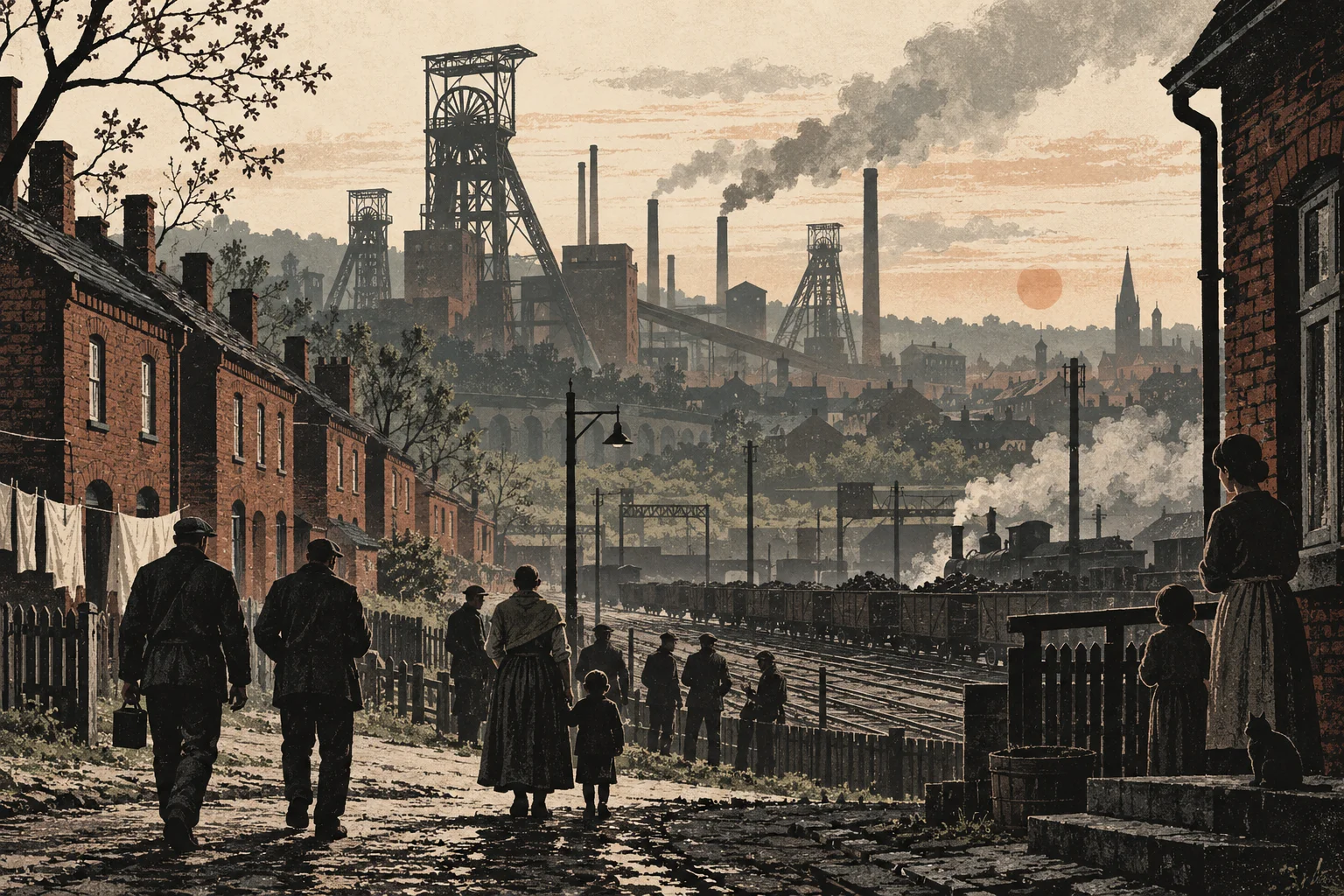
Coal mines, steelworks and their railway connections gave the region importance beyond local politics. The border dispute also concerned access to raw materials, production and markets. Partition of the industrial district had to account for an interdependent economic network.
Sources for this passage
- Treaty of Versailles, Article 88 and Annex; editorial notes in FRUSArticle 88 Annex §5; Fic: Record turnout and results
- Upper Silesia plebiscite – an intensive course in Polish identityArticle 88 Annex §5; Fic: Record turnout and results
Language and identity
Household language did not determine national identification or a plebiscite vote. Some inhabitants used Polish or Silesian varieties of speech while favouring Germany. Regional, religious and family attachments could overlap with Polish or German affiliations.
Sources for this passage
- Celebrating the nation: the case of Upper Silesia after the plebiscite in 1921Identity: pp. 50–51; Fic: paragraphs on language and propaganda
- Upper Silesia plebiscite – an intensive course in Polish identityIdentity: pp. 50–51; Fic: paragraphs on language and propaganda
Catholicism provided an important shared social world for many inhabitants. Both plebiscite campaigns appealed to religion, culture and economic expectations. Research shows that national categories used by governments did not always match the ways people identified themselves.
Sources for this passage
- Celebrating the nation: the case of Upper Silesia after the plebiscite in 1921Identity: p. 51; Fic: campaign arguments
- Upper Silesia plebiscite – an intensive course in Polish identityIdentity: p. 51; Fic: campaign arguments
Sources
- Upper Silesia plebiscite – an intensive course in Polish identity
University editorial interview with Maciej Fic · University of Silesia · 2021-03-19
- I powstanie śląskie (1919 r.) – okoliczności wybuchu
Mirosław Węcki · IPN / Przystanek Historia · 2020-08-16
- Celebrating the nation: the case of Upper Silesia after the plebiscite in 1921
Andrzej Michalczyk · UCL Discovery (research repository)
- Treaty of Versailles, Article 88 and Annex; editorial notes in FRUS
Allied and Associated Powers; US Department of State editors · Office of the Historian, US Department of State · 1919 (treaty); 1947 (FRUS volume)
If a source is unavailable, search its title and archival reference with the named institution. A missing document is not replaced with a reconstruction.